Your ADHD doesn't stay the same all month.
So why are you still treating every week the same?
If your focus, motivation, emotional regulation and ability to start things seem to disappear for the same stretch every cycle, you're not imagining it,
and you're not broken.

This is an interactive tool that teaches you how your hormones affect your ADHD, energy, focus, emotions and productivity throughout your cycle, and what to change to support yourself through it. It opens on the phase you are actually in, so the hard weeks stop feeling like a personal failure. Save it to your home screen like an app, in two simple steps. No App Store required.
You already know this week
It is about nine days before your period, and you have been looking at the same task for forty minutes.
You know what it is. You know it would take eleven minutes. You cannot start it.
Your medication feels like water today. Someone replied "ok" to your message and you have read it four times, looking for what they meant by it. The kitchen light is too bright and the fridge is too loud and your partner has asked one reasonable question too many.
By eight o'clock you are in bed with your phone, doing the thing you do at this exact point every month. Quietly building the case against yourself. That you are lazy. That you are too much. That everyone else manages this.
Then, four or five days later, it lifts. And you decide that this time you will stay on top of it.
You have made that decision more times than you can count. And if it has got harder as you have got older, that is not you imagining it.
Your dopamine has a schedule
Oestrogen rises and falls across your month. The dopamine your ADHD runs on rises and falls with it.
So that week is not a character flaw with a date on it. It is the week your oestrogen dropped and took your dopamine with it.
And that is why your medication feels weaker. It works on the dopamine you have, and for one week a month you have less of it. That is not tolerance, and it is not your prescription failing. There is a specific thing to do about the week around it.
Then your nervous system loses its buffer in the same week. Something has been quietly taking the edge off all month, and just before your period it withdraws. That is why the noise is louder, the reply you have read four times lands harder, and everything costs more than it did a week ago.
Less dopamine, and no buffer, arriving together. Nobody tells you either one.
You were never inconsistent. You were consistent with a chemistry schedule nobody handed you.
What your cycle is doing to your ADHD
You have gone looking for this. In comment sections at 11pm, in the threads where women describe exactly this and nobody comes back with anything solid.
What you found was about your body. What to eat, when to rest, which phase you are in. Your body is only half of it. The brain sitting on top of it behaves differently in the same week, and that is the part that decides what the week actually costs you.
And it does not behave the way general cycle advice assumes. In studies of women without ADHD, attention in the middle of the luteal phase holds steady, and sometimes sharpens. In studies of women with ADHD it goes the other way. So the week a general cycle app calls your steady one can be the week you cannot find a word or finish a sentence.
So that is what this adds. An interactive guide you open on your phone that tells you not just what is happening to your body this week, but what it is doing to your focus, your drive and your patience, and what to do about it in the week you are actually in.
What actually changes
This is not a PDF you download and forget. It is an interactive web guide that lives in your browser on your phone or laptop. You give it one date, the first day of your last period, and it opens on the week you are in right now. Every time you come back, it is already on the correct phase. No tracking to maintain. No streaks to break.
You know what week you are in, and roughly what it is going to cost you
At the moment each hard week arrives without warning, and the not seeing it coming is a good half of what makes it hard. After a couple of months you know. You stop booking the difficult conversation into the worst week of your month, and you stop lying awake working out why last Tuesday was fine and this Tuesday was not.
You are not making decisions in the week you cannot make them
The decisions that break a hard week are all small ones. What to eat when nothing is ready. Whether to go. Whether to reply now. Whether the session is worth it today. They get made in advance, on a day when making them is easy, so that by the time you need them there is nothing left to work out.
You stop wondering whether your medication has stopped working
There is a stretch most months where it feels like it is doing less, and the conclusion you reach on your own is almost always about you. That it is failing. That you are building a tolerance. That something has changed for the worse and you will have to start again. None of those is what is happening, and knowing that is the difference between an anxious month and an ordinary one.
You can be believed
You walk into the appointment able to say what happens, when it happens, how long it lasts and what it is called, instead of "I feel awful sometimes and I do not know why." That is not about being taken more seriously as a person. It is about arriving with the one thing a doctor can actually work from.
The month stops reading worse than it actually was
You remember the bad weeks in detail, because you were paying close attention while they happened. The good ones disappear, because nothing about them needed noticing. So the story you end up telling yourself about the month gets built almost entirely out of its worst quarter. That is the part that stops.
You stop paying for the days you did not eat
On a stimulant, hunger stops turning up, and it goes quietest in the week your calendar is fullest. A whole day goes past on coffee and whatever was on the bench, and the crash lands squarely on the week that was already going to be the hardest one you had.
On the pill, PCOS, postpartum, or no periods right now? It asks at setup, then tells you what it can actually do for you rather than guessing at a phase you do not have. The fuel numbers, the food, the medication chapter and the whole Learn tab are yours either way.
What changes when you stop fighting the same week every month
The hard stretch still arrives. What stops is the story you tell yourself about it.
Instead of "I am lazy, flaky, too much," you get "I am on day 24 and my dopamine support is down. Here is the smaller version that still counts."
The part that is only true for you is this: your ADHD is running on the same hormone that is dropping. Plan for that and the week still arrives. It just arrives somewhere you have already been, with the decisions made, the food already in the freezer, and a name on the thing that is happening to you.
So it is nine days before your period again. The same task, the same forty minutes. What is different is that your phone already knows what week this is. It tells you that starting is the expensive part right now, and it offers you a version of the task you can actually begin. You do that one. At eight o'clock you go to bed without building the case.
This is the missing layer between "I know my cycle affects me" and "I know what to do about it this week."
You honour your cycle. It does not get to run your life.
Nothing locks and nothing is scored. No streaks, no guilt, no four-week protocol to get right. Every suggestion stays a suggestion, and missed days are information rather than verdicts.
You will not be told to shrink your life, and you cannot fall behind on this. You give it one date and it does the tracking. Open it after three weeks away and it is already on the right week.
And it will not tell you that you can only train hard one week in four. The movement guidance here is built on what the research actually found, not on the standard cycle-syncing script, and it lands somewhere different. The weight on the bar does not need to consult a calendar.
If your cycle is not predictable, it will not invent a phase for you. It says so, and points you at the parts that work regardless. It was built for you too.
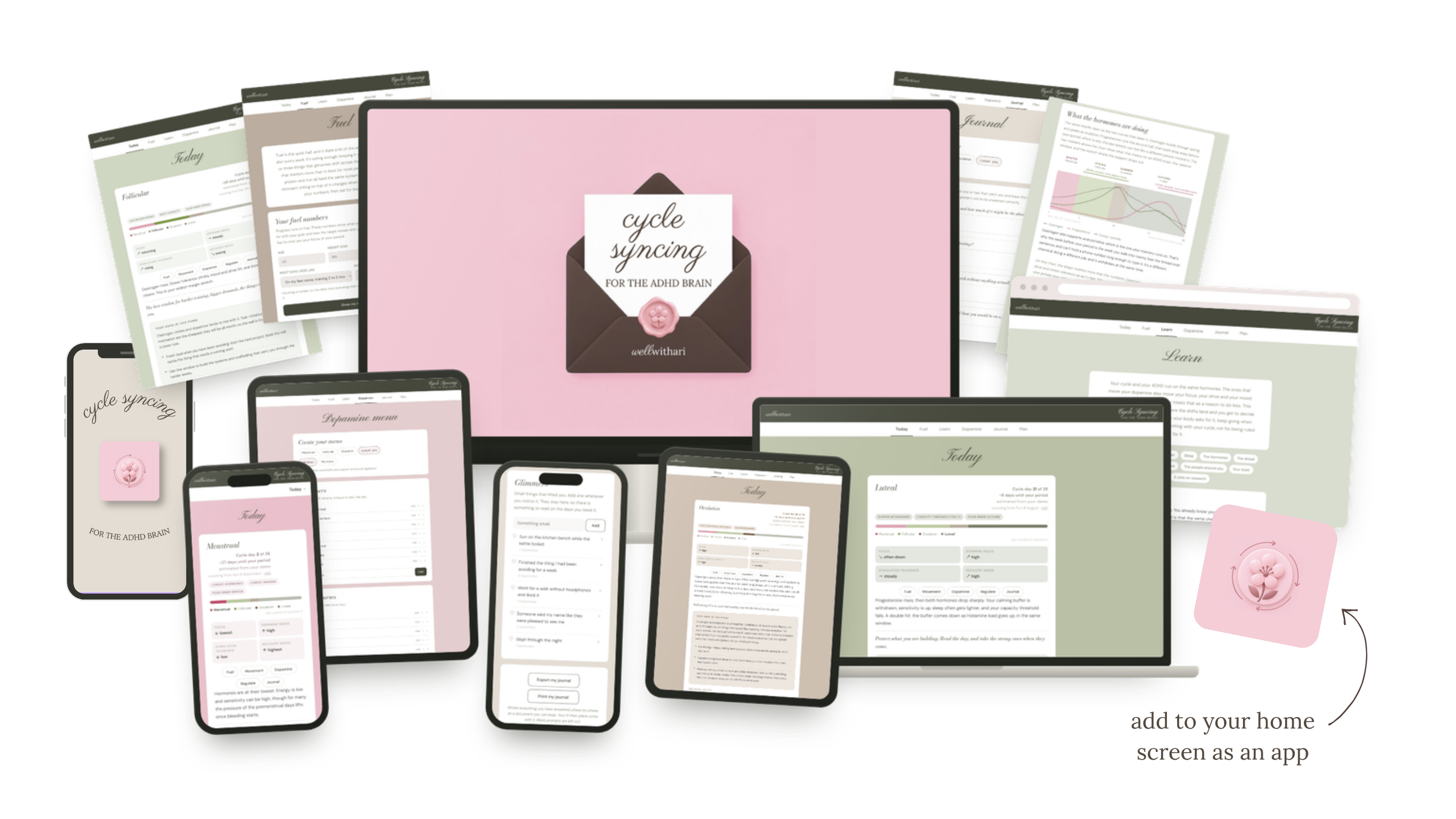
Cycle Syncing for the ADHD Brain
An interactive web guide that lives in your browser. Give it one date and it opens on the week you are actually in, every time you come back.
- Phase-aware ADHD guidance that updates with you
- If-then plans written when deciding is easy, used when it is not
- Four movement options, from a full session down to just enough to say you moved
- Food and fuel that match the phase, including around stimulants
- Why your medication feels weaker before your period, and what to do
- Why the week before your period hits your nervous system harder, plus four ways to steady it
- Luteal protection plan + hard-moment lookup card
- PMS, PMDD or PME, and the words to take to your doctor
- Journal prompts for every phase, saved so you can compare cycle to cycle
- Glimmers: a place to save the small good things, to read back on the hard days
- Your next three cycles on your calendar
- Works with natural cycles, contraception, PCOS, postpartum, or no periods
Pay once, updates included.
Sync Your Brain NowOne date. Then it runs itself.
Your next hard week already has a date on it.
So does the one after that, and the eleven after those. You can find out which weeks they are right now, and meet the next one with a plan instead of a verdict against yourself.
Start SyncingA 2026 review of twenty-nine studies found ADHD symptoms rise and fall with oestrogen, and flare hardest when oestrogen is lowest. None of this is new. It just almost never reaches the women it is about.